
Cobb County's Most Wanted Program
The Cobb County Sheriff's Office runs the county's official Most Wanted page. It features a small set of profiles tied to priority warrants and pairs them with a plain safety warning. What it does not do is promise completeness. It skips city-court warrants, warrants held by other agencies, and most active warrants the Sheriff has not chosen to feature. The right move is to open the official Cobb County Most Wanted page, read the Sheriff's current instructions, and send anything useful through the channels listed there. Contact and apprehension belong to law enforcement, not the public. This program page links to the source rather than republishing names, photos, mugshots, or charges, since the Sheriff's own display is the only current record of what appears.
Cobb Most Wanted Is Curated
A most-wanted page is not a searchable warrant database. Cobb County builds its page from fixed profile cards, each with a wanted-for narrative plus slots for a photo and physical description. There is no name-search box, no case or status filter, no warrant number field, and no bond, judge, pagination, or export tool anywhere on the public page.
Key Point: The Cobb County most wanted list is a selected program page, not a full county warrant index.
The Cobb County Sheriff posts no public full-text active-warrant search. Two court tools, the Magistrate Judicial Records Search and State Court CourtConnect, may show warrant-related case entries, but neither is a live warrant roster. Anyone checking a possible warrant in their own name should contact the issuing court or call Sheriff Warrant Information at (770) 499-4634.
How the Most Wanted Lists Work
Selection on the curated page belongs entirely to the Sheriff. The Sheriff publishes no formula for choosing profiles, no update schedule, and no as-of stamp, so a card can change after an arrest, a surrender, a recall, or action by another agency, and only the Sheriff can say when the public page reflects it. Keep the limits in proportion. A missing name on the Cobb County most wanted list proves nothing about whether a warrant exists, since a warrant can be new, sealed, juvenile, tied to an open investigation, held by a municipal court, entered only in a law-enforcement system, or filed under different identifying details. For a real answer on a specific person, the issuing court holds the record. A warrant, after all, is just a court order that starts process, and the case then moves through court like any other.
Note: Because no update cadence is published, confirm current warrant status with the Sheriff or issuing court before relying on the page.
Cobb Most Wanted Profile Limits
Each public profile carries enough for the Sheriff's program and little more. Cobb County shows wanted-for text, height, weight, a photograph slot, and a tip contact. No warrant number, case number, bond amount, status code, issuing judge, or next court date appears on the page.
- Program profile
- A public card selected by the Sheriff for the Most Wanted page.
- Active warrant
- A warrant not shown as served, recalled, quashed, or otherwise closed in the custodian's system.
- Warrant confirmation
- A current answer from the Sheriff or the court that issued the warrant.
- Wanted-for text
- The program's reason description, which is not a final finding of guilt.
That limit is deliberate. A profile is a doorway to an official tip channel, nothing else. It is not a court file, and it is never a license for Cobb County residents to investigate someone or make contact themselves.
Reporting a Tip Safely
The official Cobb County page sends tipsters to the Sheriff's Office at (770) 499-4633 or to a local police agency. The Sheriff's contact directory also lists Most Wanted at (770) 499-4630 or (770) 499-4639. If the numbers differ, follow the current instructions on the official page.
- Do not approach, confront, follow, detain, or try to apprehend anyone.
- If there is an immediate threat, use emergency services; otherwise use the published Sheriff or local police contact.
- Give the location and direct facts you observed, without adding guesses or posting the information publicly.
- Follow the receiving agency's directions, step away, and let trained officers decide how to respond.
Key Point: Report useful facts to law enforcement and step back. The Cobb Sheriff expressly says not to attempt apprehension.
The official Most Wanted page posts no reward amount and no reward-claim procedure. Treat a tip as anonymous or reward-eligible only if the receiving agency in Cobb County says so.
Cobb Most Wanted Service Partners
The scale behind the program is large. The Cobb County Sheriff's Warrant Section receives more than 28,000 criminal warrants in an average year, and that figure counts annual intake, not open warrants or unique people. Staff enter each warrant into the internal database, verify identity and criminal history, may place wanted information in NCIC, and route papers for service by uniform deputies or the Fugitive Section. Specialized units carry the risk. FAST handles high-risk warrants and transports, SWAT can assist with dangerous service, and the U.S. Marshals Service Southeast Regional Fugitive Task Force counts the Cobb County Sheriff's Office among its partners. Those layers are exactly why the public should pass information to official contacts rather than act on it. The official Austell Municipal Court source shows a local court's warrant and appearance framework, with no private roster on display.
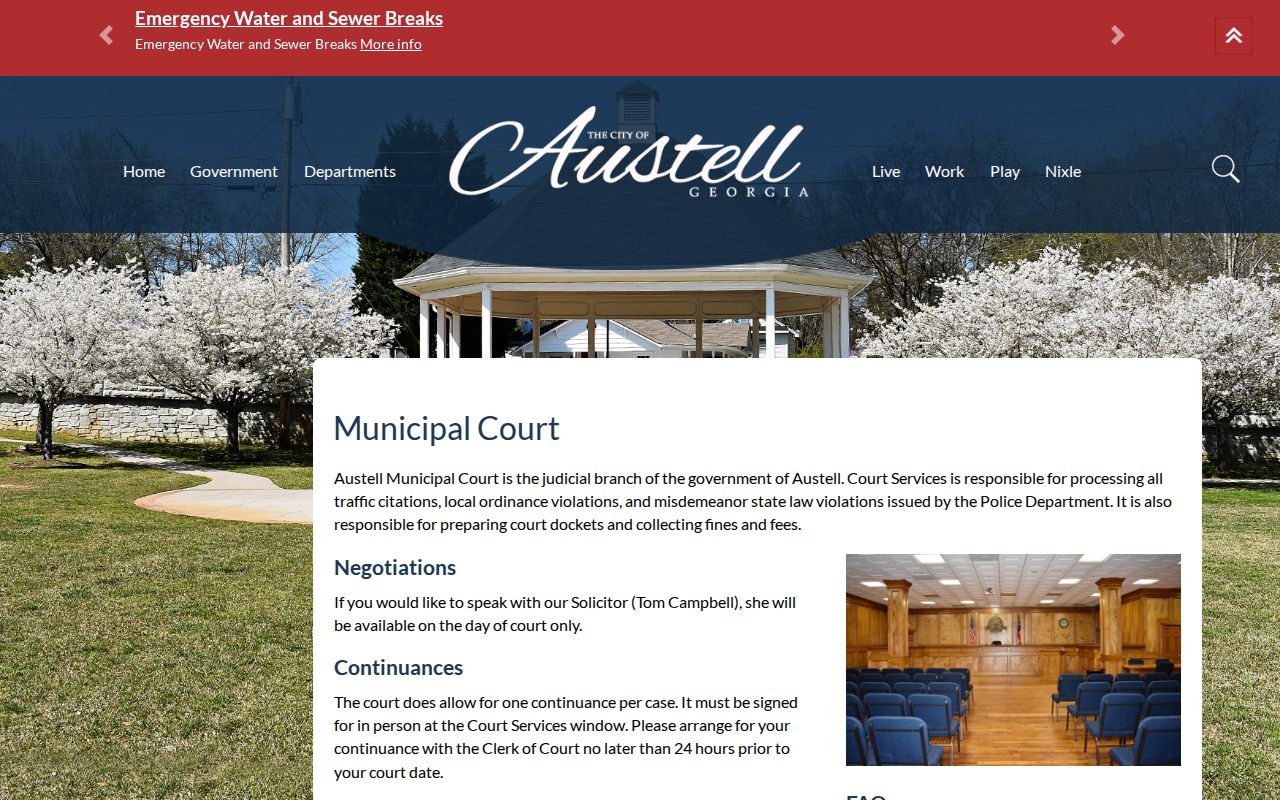
It makes a simple point. Many Cobb County warrants begin at an issuing court like this one, even though the Sheriff's selected program runs countywide.
Most Wanted Lists vs Active Warrants
A profile and an active warrant overlap only by choice. Cobb County features a warrant on its most wanted page only when the Sheriff selects it. Most never become profiles. For your own case, court records are the better route.
| Feature | Most Wanted List | Active warrant record |
|---|---|---|
| Scope | Curated Sheriff subset | Any warrant still open in the custodian's system |
| Public route | Official program link and tip contact | Issuing court, Sheriff phone, case search, or records request |
| Fields | Program narrative and descriptor areas | May include number, court, charge, filing, hearing, or bond data |
| Meaning | Agency-selected public priority | Judicial order that has not been closed in the relevant system |
| Resolution | Attorney-guided confirmation and lawful surrender | Court-directed recall, appearance, surrender, bond, or service |
The Cobb outstanding-warrants guide walks through the fuller confirmation chain. A name match alone, on either list, establishes nothing.
Cobb Most Wanted Does Not Replace Courts
Cobb County splits its court work across several venues, so a most-wanted page can never answer for all of them. Magistrate Court, at 32 Waddell Street, takes arrest-warrant applications, preliminary proceedings, and bond matters. State Court holds the misdemeanors and unincorporated traffic files, Superior Court holds felony cases after bind-over, and six municipal courts handle city traffic, ordinance, and qualifying misdemeanors. Checking your own name starts with the likely issuing venue. The Magistrate Judicial Records Search accepts a name, case number, or citation number, while CourtConnect covers criminal cases by name, birth year, filing date, or case number. Unsure which court holds the warrant? Call Sheriff Warrant Information at (770) 499-4634. If the public searches turn up nothing, file a narrow Sheriff GOVQA or Magistrate records request. Georgia has no statewide public warrant database; GCIC and NCIC serve law enforcement only, and DDS tracks traffic failure-to-appear consequences rather than active warrants in Cobb County.
If You Think You Are on a List
Skip the old snapshots and third-party sites; they go stale fast. If a Cobb County listing looks like you, call a Georgia attorney before you act. A lawyer can reach the Sheriff and the court, confirm the active warrant, and ask whether bond is set. From there, the path may run through an appearance, a motion to recall, surrender, booking, or bond.
- Write down the exact official source and the date you saw it.
- Contact counsel before approaching a law-enforcement office or detention site.
- Confirm the issuing court, warrant number, charge, bond status, and surrender instructions.
- Follow the issuing court's order and keep all receipts, release papers, and new court dates.
- Recheck with the court and Sheriff after action is taken; a web page can lag.
Important: Do not go to confront anyone or attempt self-help. Counsel can confirm the warrant and coordinate a lawful response.
Cobb Most Wanted Record Boundaries
Georgia's Open Records Act, O.C.G.A. §§ 50-18-70 through 50-18-78, gives you access to records that exist, subject to exemptions. The Sheriff offers a GOVQA request route, and Cobb County's Open Records Center can send a request to the right office. Agencies generally answer within three business days or tell you the timing, the costs, and the basis for any exemption. The law does not force the Sheriff to build a full Most Wanted or active-warrant report that was never created. Active-investigation material, sealed records, juvenile information, and protected personal identifiers may be withheld or redacted. Juvenile Court records are restricted, so never treat them as a public warrant list. Ask only for the existing record you need for your own or a relative's matter. Give the known court, the case number, the approximate date, and the agency. The official Most Wanted link is a public-safety program, nothing more.